The Multitasking Trap: Why Your Brain Can't Handle It
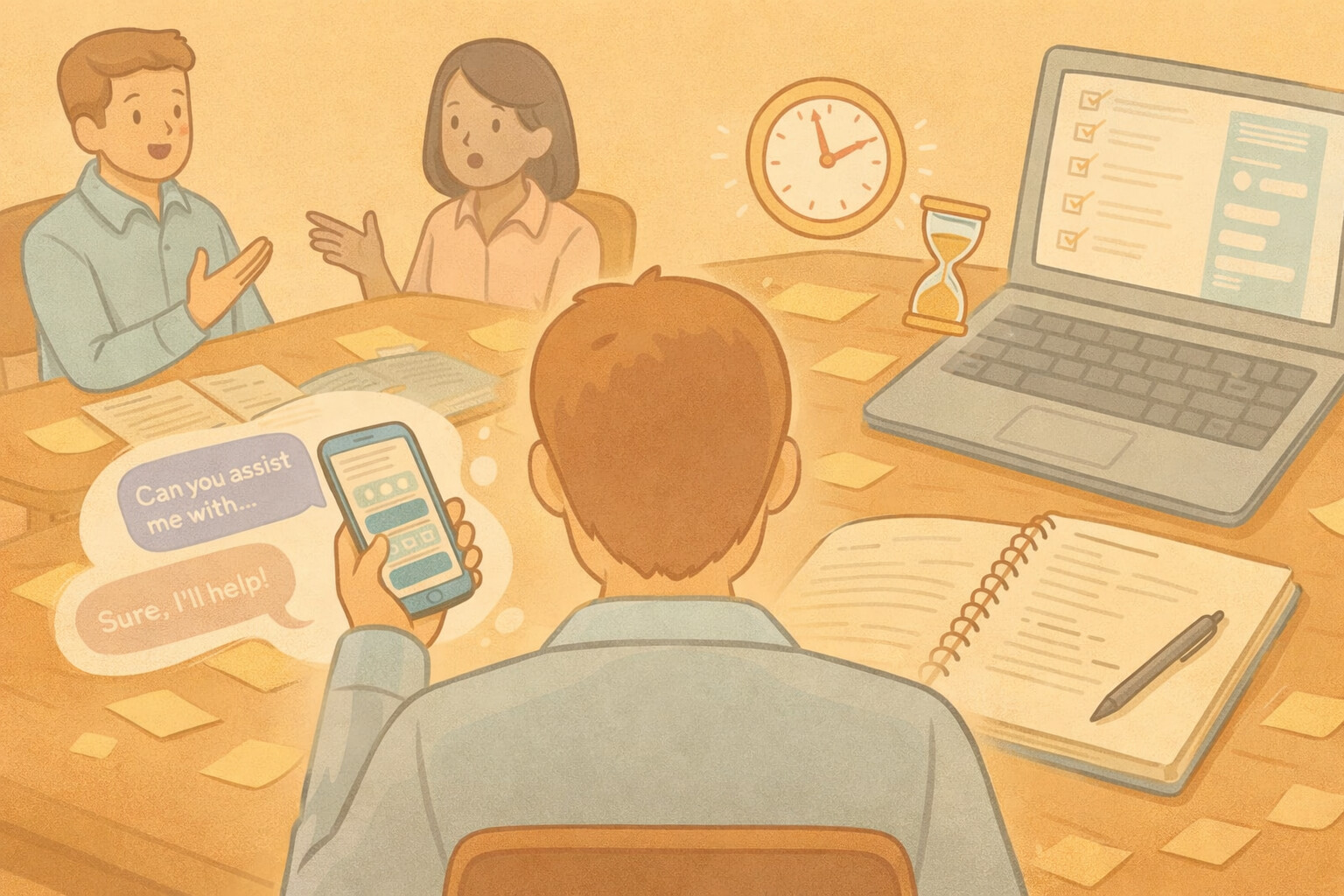
You're writing an email while listening to a podcast, glancing at Slack notifications, and mentally planning tonight's dinner. You feel productive, accomplished even. Like you're getting so much done at once.
Wake up, it's an illusion:
You're not actually multitasking. You're rapidly switching between tasks, and it's costing you more than you think.
What is multitasking, really?
Multitasking sounds impressive. It creates images of productivity superheroes juggling multiple projects simultaneously, accomplishing in hours what takes mere mortals days. The reality is far less flattering.
True multitasking, processing multiple tasks in parallel, is something your brain simply cannot do. What we call multitasking is actually rapid task-switching. Your brain jumps from one task to another, giving each a sliver of attention before moving on.
According to research from the American Psychological Association, this constant switching can reduce productivity by as much as 40%. That's nearly half your potential output lost to the illusion of efficiency.
The brain science behind it:
Your prefrontal cortex can only focus on one complex task at a time. When you switch tasks, your brain needs to disengage from the first task, shift attention, and re-engage with the new task. This process isn't instantaneous, it creates what neuroscientists call attention residue.
Why does multitasking feel so productive?
If multitasking is so inefficient, why does it feel like you're accomplishing so much? Because your brain is working overtime. All that switching, all that mental gymnastics, creates a sense of busyness that we mistake for productivity.
Research from Stanford University found that people who regularly multitask are actually worse at filtering out irrelevant information and switching between tasks than those who focus on one thing at a time. ironically, the more you multitask, the worse you become at it.
How is context switching harmful?
Your focus gets destroyed
Deep work requires sustained attention. When you're constantly switching contexts, you never reach that state of flow where your best thinking happens. You remain perpetually on the surface, skimming instead of diving deep.
Every time you switch tasks, your brain needs time to adjust. Studies suggest it can take up to 23 minutes to fully regain focus after a distraction. How many times do you switch tasks in an hour? Do the math. You're never fully focused.
Quality goes downhill
When your attention is divided, so is your output. That email you wrote while half-listening to a meeting? It probably needs revision. The code you wrote while monitoring Slack? Full of bugs you'll spend tomorrow fixing.
You might finish more tasks, but you'll spend additional time correcting mistakes, clarifying misunderstandings, and redoing work that wasn't done properly the first time.
Overwhelm takes over
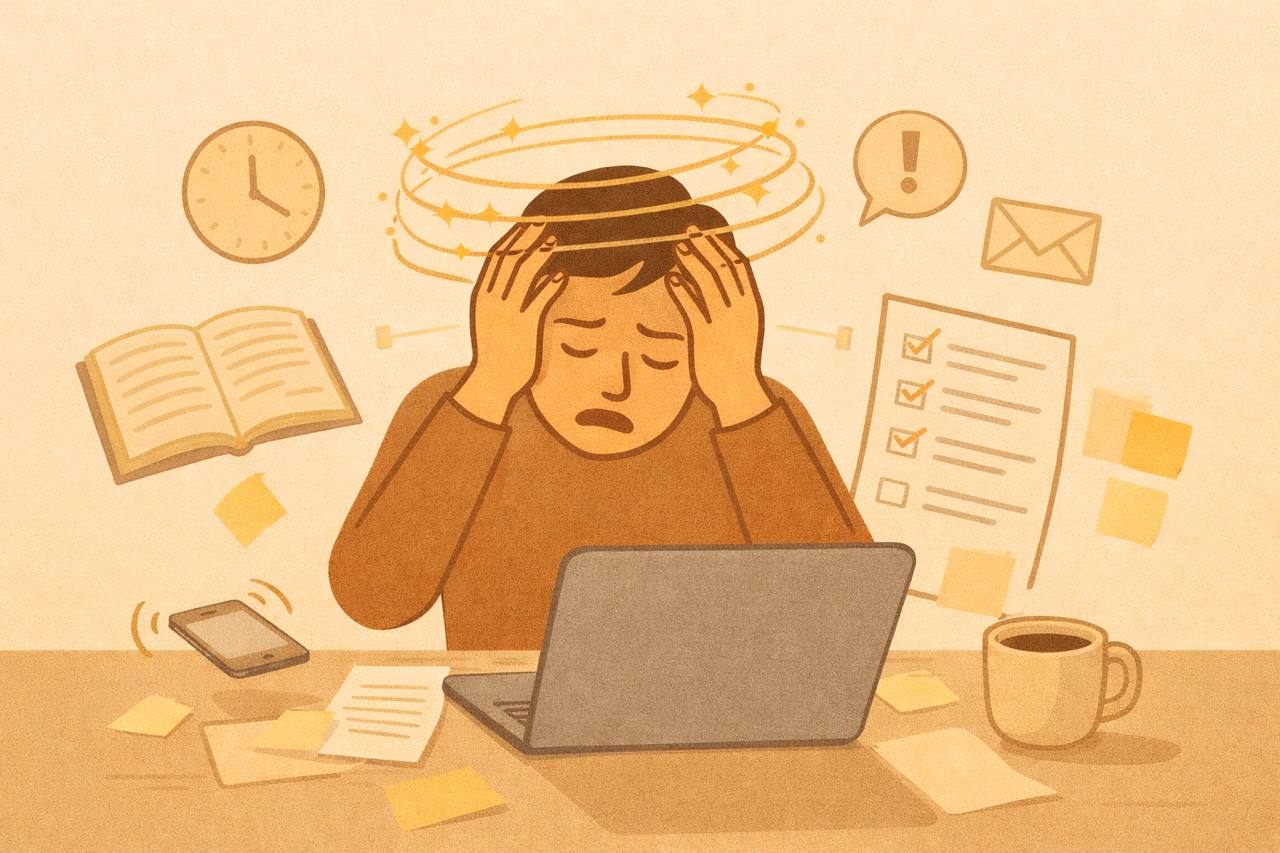
Juggling multiple tasks simultaneously keeps you on the edge, you will feel like you are under constant pressure trying to catch up, leading you to feel mentally exhausted and tense.
When is multitasking actually okay?
Before you vow to never do two things at once again, know this: not all multitasking is created equal. There are scenarios where handling multiple tasks simultaneously works just fine.
- Pairing automatic tasks with focused ones Listening to a podcast while doing dishes? Fine. Walking while brainstorming? Great. One task is automatic enough that it frees your mind to focus on the other.
- Combining passive and active tasks Letting code compile while reviewing documentation works because one task doesn't require active attention.
- Simple, routine tasks done together Sorting emails by sender while categorizing by urgency is manageable because both tasks are simple and use similar mental processes. You're not forcing your brain to jump between completely different modes of thinking.
The key difference: multitasking works when at least one task requires minimal active thinking. It fails spectacularly when both tasks demand your full attention.
Simple rule:
If both tasks require problem-solving, creativity, or careful attention, don't multitask. If one task is essentially automatic, you're probably safe.
Monotasking
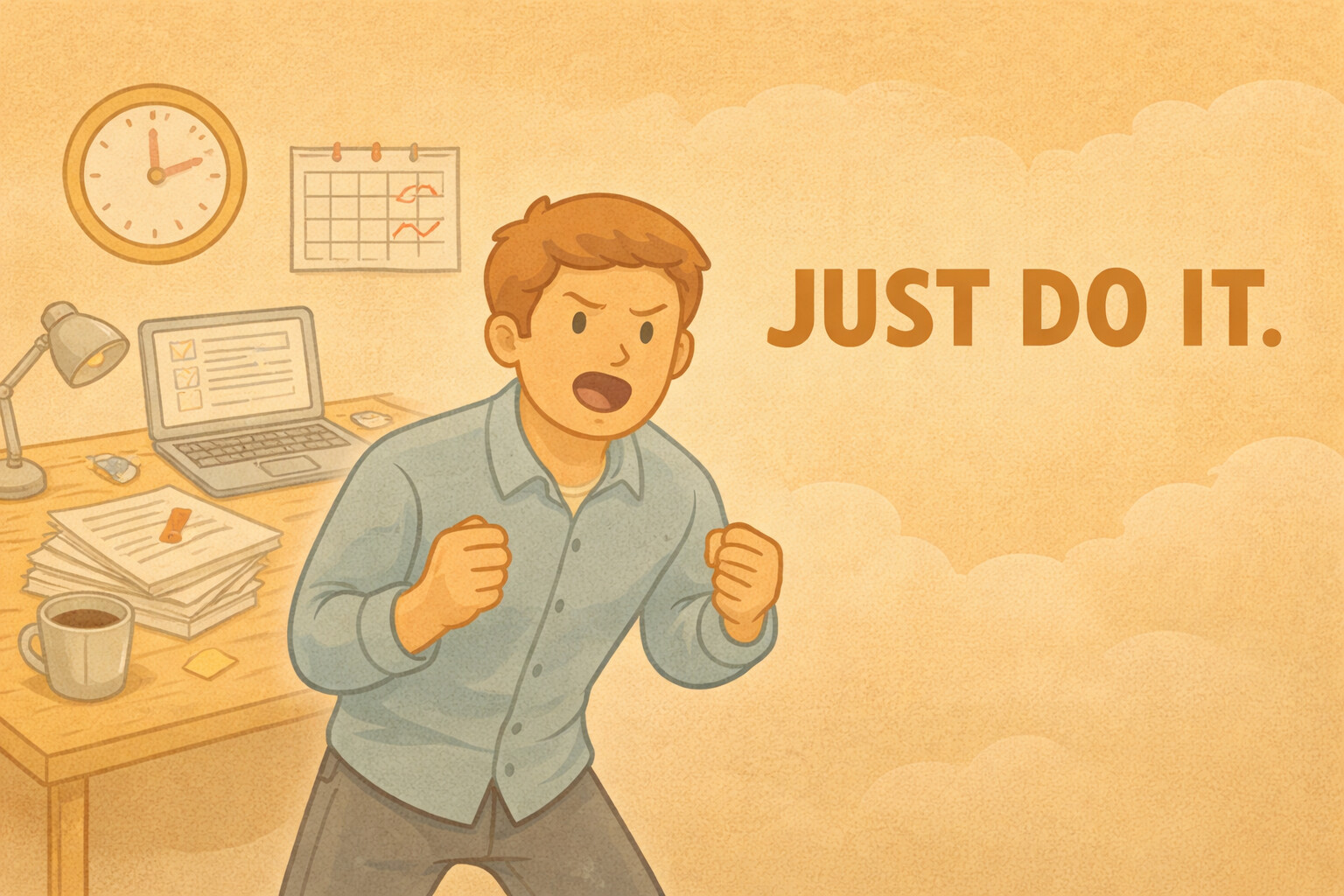
Here's what happens when you take tasks one at a time: You finish faster. You make fewer mistakes. You produce higher quality work. And oddly enough, you feel less overwhelmed despite the same workload.
The next time you catch yourself trying to do three things at once, pause. Pick one. Finish it. Then move to the next. You'll accomplish more in less time, with better results and lower stress.
Why do we keep falling for the multitasking trap?
Because modern work culture glorifies busy. We mistake activity for achievement, confuse motion with progress. Saying "I'm multitasking" sounds more impressive than "I'm doing one thing at a time."
Multitasking is the art of doing many things poorly. Single-tasking is the discipline of doing one thing well.
The takeaway isn't that you should never multitask. It's more about knowing when it actually helps, sometimes it does work, but more often than not, it just gives the illusion of getting more done while it's quietly becoming your achilles' heel.
Need a system that keeps up with your focused work without forcing constant organization? Try MindMirror free for 7 days. Capture ideas quickly during deep work sessions and find them instantly later with powerful semantic search. No folders, no tags, no interrupting your flow.
Share this post